The PEACE Protocol: A Somatic Practice for Stress and Nervous System Regulation
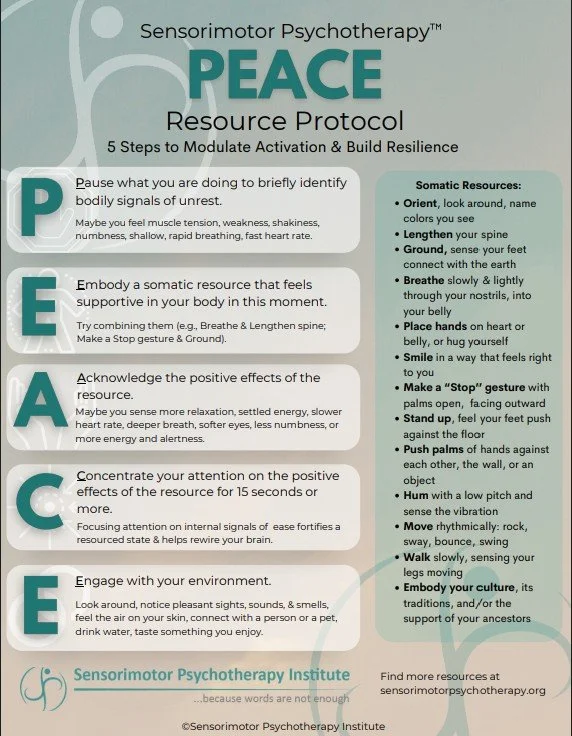
Understanding a five-step Sensorimotor Psychotherapy resource developed by Pat Ogden, PhD
When stress builds, we often try to think our way out of it. We analyze what happened, remind ourselves that we should calm down, distract ourselves, or attempt to reason with thoughts that seem to be moving faster than we can manage them. Sometimes this helps. At other times, however, the body continues to respond even when we understand intellectually that there is no immediate danger.
You may notice this as tension in your shoulders or jaw, shallow breathing, restlessness, a racing heart, difficulty concentrating, numbness, fatigue, or a sense that you cannot quite settle. These experiences do not necessarily mean something is wrong with you or that every uncomfortable sensation represents trauma. They can simply be signs that stress is showing up not only in your thoughts, but also in your physical experience.
Somatic approaches invite us to become curious about this connection. Rather than focusing exclusively on what we are thinking, we begin noticing posture, movement, breath, muscle tension, physical sensations, impulses, and our awareness of the environment around us.
One structured way of practicing this type of awareness is the PEACE Resource Protocol, developed by psychologist Pat Ogden, PhD, founder of the Sensorimotor Psychotherapy Institute. PEACE is a five-step somatic resource practice designed to help people notice activation, access supportive physical resources, and reconnect with themselves and their surroundings. The Sensorimotor Psychotherapy Institute describes the protocol as a resource for supporting presence, emotional regulation, inner stability, and resilience.
The five steps are Pause, Embody, Acknowledge, Concentrate, and Engage. Although the sequence is simple, the intention is not to force yourself to relax or make uncomfortable emotions disappear. Instead, the practice encourages you to notice what is happening in your body, experiment with something that feels supportive, and pay attention to whether anything shifts.
Why Somatic Resources Can Be Helpful During Stress
Stress is not experienced only as a thought. It can influence attention, breathing, muscle tension, energy, sleep, concentration, and the way we respond to people and situations around us. When we are overwhelmed, it can become difficult to access the perspective we might have when we feel more settled.

This is one reason body-based resources can complement traditional psychotherapy. Sometimes it is helpful to understand why you are anxious or overwhelmed. At other times, you may already understand exactly why you feel the way you do and still notice that your body remains tense, restless, shut down, or on alert.
A somatic resource gives us another place to begin. Rather than asking only, “What am I thinking?” we can also ask, “What am I noticing in my body right now, and is there anything that helps me feel a little more supported?”
This does not require achieving complete calm. In fact, attempting to force yourself into relaxation can sometimes create additional frustration. A more realistic goal may be noticing a small shift, such as taking a fuller breath, feeling your feet more clearly against the floor, softening your shoulders, becoming more aware of the room around you, or feeling slightly more present.
P: Pause
The first step of the PEACE Protocol is Pause.
Pausing creates a brief interruption between what is happening and our automatic response to it. Instead of immediately trying to solve the problem, suppress the feeling, or push through the discomfort, we take a moment to notice what is actually happening.
You might ask yourself what you are aware of physically. Perhaps your shoulders have lifted toward your ears without you realizing it. Your breathing may have become quick or shallow. You may notice pressure in your chest, tension in your stomach, trembling, heaviness, numbness, or a feeling of wanting to move.
The purpose of pausing is not to interpret every sensation or decide what it means. It is simply to notice.
This distinction can be particularly important for people who are accustomed to functioning through stress. If your usual response is to keep working, solving, caretaking, planning, or managing everyone around you, you may not recognize how activated or depleted you have become until the stress is significant.
Pausing creates an opportunity to gather information before deciding what you need.
E: Embody
The second step is Embody, which involves experimenting with a physical resource that feels supportive in the moment.
Sensorimotor practices can include grounding through the feet, adjusting posture, breathing more slowly, using supportive self-touch, orienting to the environment, making a protective gesture, walking, gently moving, or noticing the sensation of physical support beneath the body. The intention is not to perform the technique correctly. It is to explore whether a particular action changes your experience in a useful way.
For example, you might notice that sitting upright and allowing your spine to lengthen gives you a greater sense of steadiness. Another person may feel more supported by pressing their feet into the floor. Someone else may prefer placing a hand over the chest or abdomen, slowly looking around the room, or standing and moving.
Different resources work for different people.
This is an important aspect of somatic work. A technique that feels grounding to one person can feel uncomfortable or ineffective to someone else. Breathwork, closing the eyes, touch, movement, and stillness are not universally regulating experiences. Personal history, culture, trauma experiences, physical health, and individual preference all matter.
The question is not, “What am I supposed to feel?” It is, “What happens when I try this?”
A: Acknowledge
The third step is Acknowledge.
After experimenting with a resource, we pause again and notice whether anything changed. The shift may be obvious, but it may also be extremely subtle.
Perhaps your breathing feels slightly easier. Maybe your shoulders lowered. You may notice more warmth in your hands, greater awareness of your surroundings, less restlessness, or simply the sense that you have a little more room inside yourself.
You may also notice very little change.
That information is useful too.
Somatic work is not about convincing yourself that an intervention worked. It involves becoming more precise about your internal experience. If pressing your feet into the floor does nothing for you, there is no therapeutic prize for pretending otherwise. You can try another resource.
Over time, this type of noticing can help you become more familiar with your own patterns. You begin learning not only what activation feels like, but also which experiences tend to support steadiness, connection, energy, or a sense of being more present.
C: Concentrate
The fourth step is Concentrate.
If you notice something supportive, you intentionally give that experience your attention for a short period of time. The original PEACE resource encourages spending at least several seconds noticing the positive effects of the resource rather than immediately moving on.
This part can feel surprisingly unfamiliar.
Many of us are very practiced at noticing discomfort. We notice the racing heart, the difficult thought, the tension, the worry, or the feeling that something is wrong. When something shifts in a more supportive direction, however, we may barely register it before returning our attention to the next problem.
Concentrating asks you to stay with the supportive experience a little longer.
You might notice the feeling of both feet against the floor, the sensation of your back being supported by the chair, the movement of a slower breath, or the increased awareness of the room around you.
The goal is not positive thinking. You are not telling yourself that everything is fine when it is not. You are simply allowing your attention to include something supportive alongside whatever difficulty is already present.
That ability to hold more than one aspect of an experience can be clinically meaningful. Distress may still be present, but it does not necessarily have to occupy the entire field of awareness.
E: Engage
The final step is Engage.
After turning inward to notice the body, the protocol brings attention outward again. You reconnect with the environment around you.
This might involve looking around the room and noticing colors, shapes, light, or familiar objects. You might listen for sounds, feel the temperature of the air against your skin, drink some water, notice something visually pleasant, connect with a pet, or speak with someone you trust. Sensorimotor Psychotherapy includes this outward orientation as the final part of the PEACE sequence.
Engagement matters because regulation does not occur only inside us. Human beings respond to context, relationships, sensory information, physical surroundings, and cues of both safety and threat.
Sometimes stress narrows our attention. We become absorbed in the problem, the memory, the conversation, or what might happen next. Re-engaging with the present environment can help widen that attention again.
You are not pretending the problem has disappeared. You are reminding yourself that the difficult experience is occurring within a larger present moment.
What the PEACE Protocol Is Not
The PEACE Protocol should not be understood as a cure for anxiety, trauma, PTSD, or nervous-system dysregulation. It is a resource practice, not a stand-alone treatment for a mental health condition.
It also should not be used to suggest that every uncomfortable emotion needs to be regulated away. Anxiety, anger, grief, fear, and sadness can carry important information. Sometimes the appropriate response to distress is not calming yourself. It may be setting a boundary, leaving an unsafe situation, grieving something painful, asking for help, or addressing a problem that genuinely needs attention.
The goal of a somatic resource is not emotional avoidance. Ideally, it gives you another way to stay connected to yourself while deciding how you want to respond.
This distinction is particularly important in trauma-informed work. A person should not be encouraged to override protective signals simply because an exercise is supposed to create calm. If a practice increases distress, dissociation, panic, physical discomfort, or a sense of disconnection, it can be stopped or modified.
Is There Research Behind Somatic Therapy?
Research on body-oriented and somatic approaches is growing, although the evidence base varies considerably depending on the particular intervention.
It is important not to take research supporting one somatic treatment and automatically apply those findings to every breathing exercise, grounding technique, or nervous-system practice found online. The PEACE Protocol itself is a clinical resource from Sensorimotor Psychotherapy, and claims about its effectiveness should remain proportionate to the available evidence.
There is emerging research on Sensorimotor Psychotherapy-informed interventions. A pilot randomized controlled trial examined a 20-session body-oriented group intervention based on Sensorimotor Psychotherapy principles for women with histories of childhood trauma. The study provided preliminary evidence supporting further investigation of this type of body-oriented trauma treatment, but the authors appropriately characterized the work as a pilot study rather than definitive proof of efficacy.
That distinction matters. Somatic interventions can be valuable components of psychotherapy, but they should not be presented as if every nervous-system exercise has been independently proven to treat trauma or PTSD.
How I Use Somatic Techniques in Therapy
At Acadia Psychotherapy & Associates, somatic techniques are used as part of an integrative psychotherapy approach rather than as a replacement for clinical assessment, therapeutic relationship, or evidence-based treatment.
A session may involve traditional talk therapy, EMDR, mindfulness, cognitive or behavioral strategies, or gentle attention to how an experience is showing up physically. Sometimes that means noticing tension or posture. At other times it may involve grounding, orienting, breath awareness, movement, or another resource that feels appropriate for the client. Somatic techniques may be incorporated into anxiety, stress, and burnout therapy when distress is showing up through both thoughts and physical activation.
Not every client needs somatic work, and not every session needs to focus on the body.
I also do not believe clients should be pushed into a technique simply because it is popular or described online as “regulating.” Therapy should remain collaborative. If something feels uncomfortable, unhelpful, culturally incongruent, physically inaccessible, or simply not like a good fit, we can approach the work differently.
The purpose is to expand your options, not give you another set of things you are supposed to do correctly.
When the PEACE Protocol May Be Useful
The PEACE Protocol may be useful during moments when you notice stress beginning to build and want a structured way to check in with yourself before automatically pushing through it.
For example, you might use it after a stressful workday, before a difficult conversation, after noticing that your thoughts are racing, or when you realize that you have been sitting at your desk with your shoulders tense and your breathing shallow for the last hour.
It can also serve as a way of becoming more familiar with your own physical responses to stress.
With repetition, you may begin noticing those responses earlier. Instead of discovering that you are overwhelmed only after reaching your limit, you may become more aware of the smaller signals that tend to appear first.
That awareness can create more choice about what you do next.
Somatic Practices Are Not About Doing Regulation Perfectly
One of the problems with some nervous-system content online is that regulation can begin to sound like another performance goal.
You may start believing you should always be calm, grounded, emotionally balanced, and capable of bringing yourself back to baseline within a few minutes.
Human nervous systems do not work that way.
We become stressed. We become activated. We feel tired, angry, afraid, excited, distracted, numb, connected, overwhelmed, and everything in between. These shifts are part of being human.
The goal is not permanent calm.
A more realistic goal is developing greater awareness of what is happening, recognizing what you may need, and expanding the number of ways you can respond when stress becomes difficult to manage.
The PEACE Protocol offers one structured way of practicing that process.
Try the PEACE Protocol With Curiosity
If you experiment with this practice, approach it with curiosity rather than expectation.
Pause and notice what is happening. Experiment with a physical resource that feels supportive. Pay attention to whether anything changes. Give a helpful shift a little time and attention. Then reconnect with the environment around you.
If the experience feels supportive, you can return to it.
If it does not, that is useful information too.
Somatic work is not about making your body behave. It is about learning to listen more carefully to what your body may already be communicating.
Learn More About Somatic Therapy in McKinney, Texas
If stress, anxiety, burnout, or difficult experiences continue to affect both how you think and how you feel physically, psychotherapy can provide a more individualized place to understand those patterns.
Acadia Psychotherapy & Associates offers therapy for adults in McKinney, Texas, using an integrative approach that may include traditional psychotherapy, EMDR, somatic techniques, mindfulness, and nervous-system-informed education depending on your needs and treatment goals.
Learn more about Somatic Therapy Techniques in McKinney, Texas.
About the Author
Elizabeth Boyer, LMFT, is a licensed marriage and family therapist and founder of Acadia Psychotherapy & Associates in McKinney, Texas. Her work with adults integrates traditional psychotherapy with EMDR, trauma-informed care, somatic techniques, mindfulness, and nervous-system-informed approaches when clinically appropriate.
References and Further Reading
Ogden, P., Minton, K., & Pain, C. (2006). Trauma and the Body: A Sensorimotor Approach to Psychotherapy. W.W. Norton & Company.
Ogden, P., & Fisher, J. (2015). Sensorimotor Psychotherapy: Interventions for Trauma and Attachment. W.W. Norton & Company.
Sensorimotor Psychotherapy Institute. PEACE Resource Protocol: Five Steps to Modulate Activation and Build Resilience. The PEACE Resource Protocol was developed within Sensorimotor Psychotherapy and is presented by Pat Ogden, PhD.
Classen, C. C., Hughes, L., Clark, C., Hill Mohammed, B., Woods, P., & Beckett, B. (2021). A Pilot RCT of a Body-Oriented Group Therapy for Complex Trauma Survivors: An Adaptation of Sensorimotor Psychotherapy. Journal of Trauma & Dissociation.